
Lantara
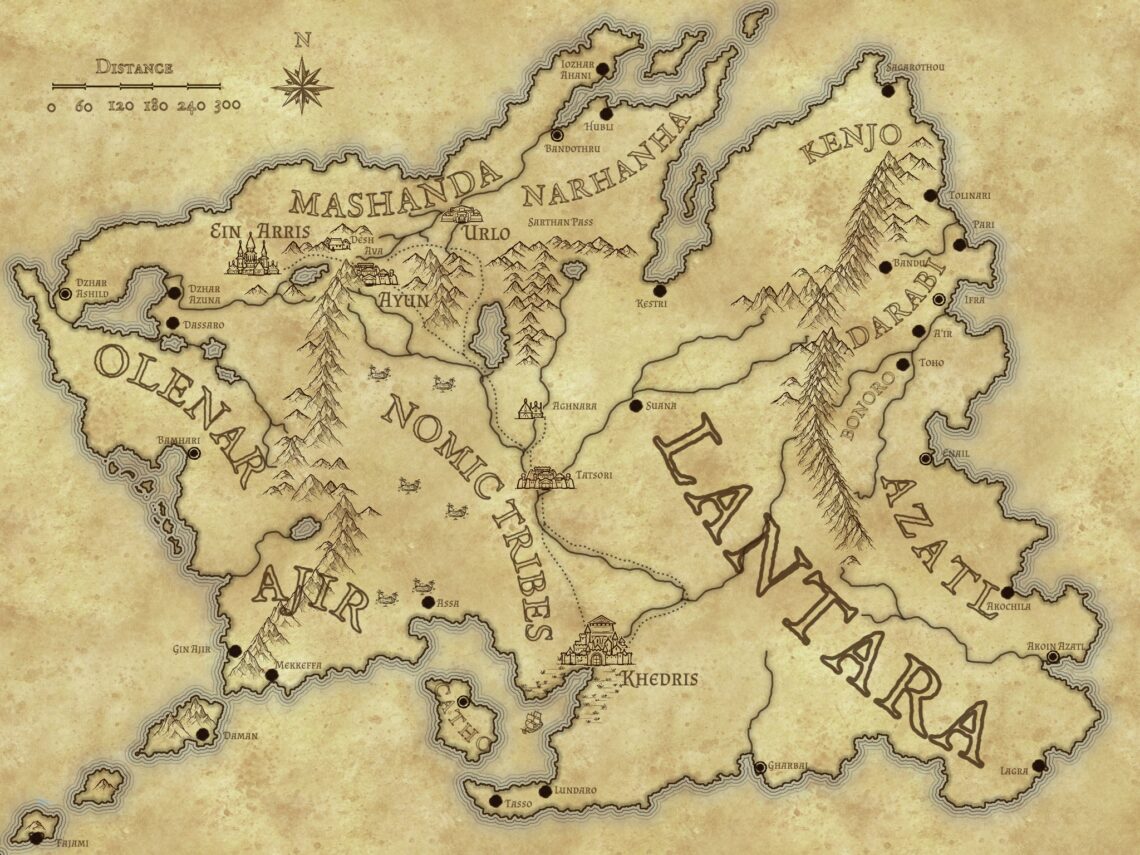
Lantara is a large land mass of about 7 million square miles. Lantara is both the name of the land mass and the name of the largest country in the region. Most of the land mass is very arid or actual desert.
Lantara is a TL3 region similar to the Middle Ages.
Countries
- Ajir
- Azatl
- Bonoro
- Catho
- Darabi
- Kenjo
- Lantara
-
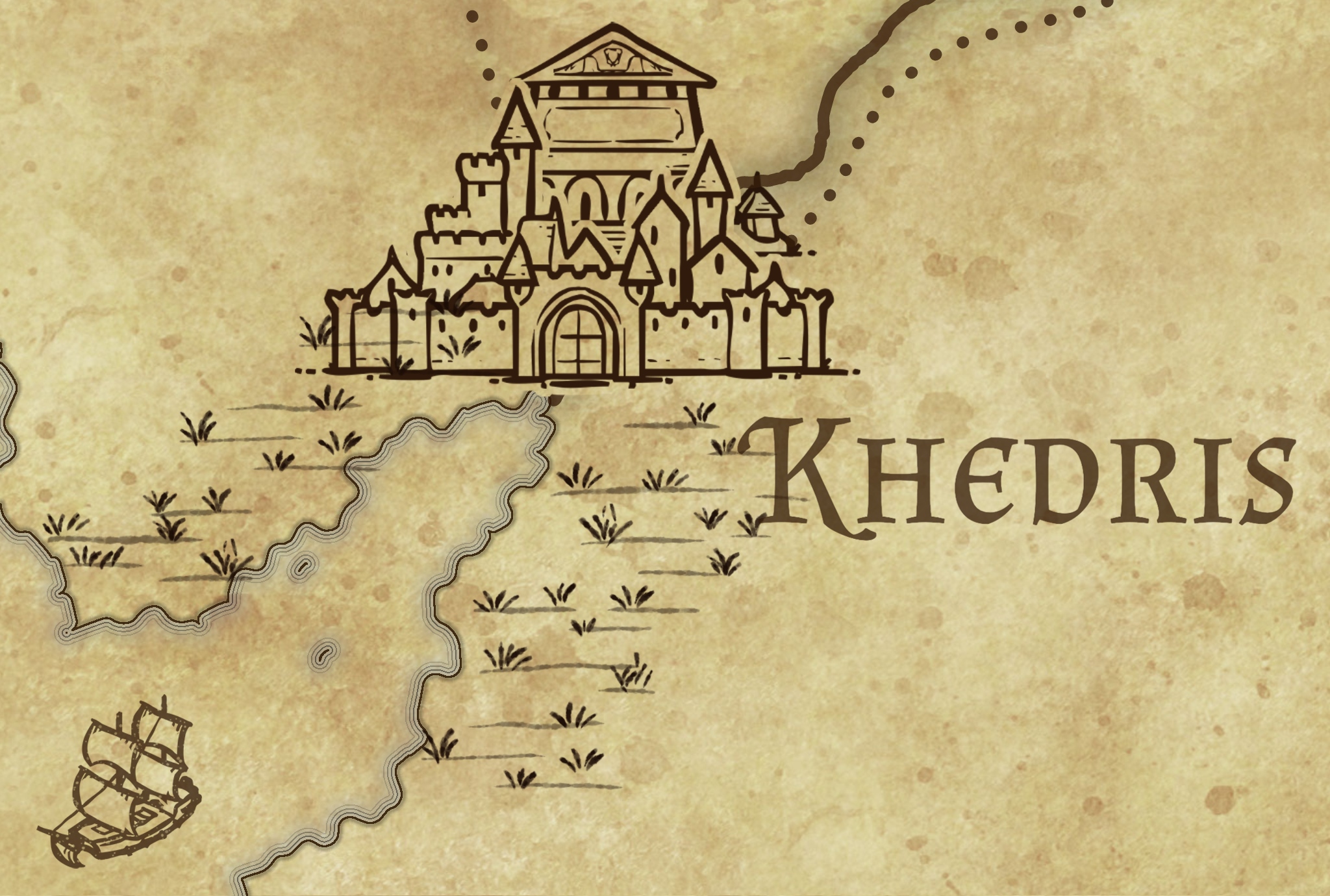
Khedris is the capital of Lantara and the home of the Khedran Emperor. The Empire comprises all the nations of Lantara, but the Emperor’s influence is limited primarily to the nation of Lantara, with actual imperial control being limited to the east side of Khedris itself. The Merchant Guild, with Guildmaster Halmaro at its head, holds the true power in Khedris and throughout the empire. Khedris is also home to the White Sword merchant mercenaries.
Khedris - Mashanda
- Narhanha
- Nomic Tribes
- Olenar
Halmaro
Guildmaster Halmaro — Master of the Guild. (Add his history and portrait here.)
Languages
- Ayuni (trade pidgin)
- For many years traders have passed through Ayun, going to and from Ein
Arris and Khedris. This constant contact has spawned a pidgin used all along
the trade route by traders of different linguistic backgrounds. Ayuni Trade
Pidgin has the sentence structure of Yat Ayun, the vocabulary of Lantrai, and
the numbers, curses, and insults of both.
Anyone knowing either Lantrai or Yat Ayun at Native level knows Ayuni Trade Pidgin at a Broken level of comprehension. It is impossible to gain a comprehension of greater than Broken in Trade Pidgin. This language could be written in Ayuni script, but nobody would ever bother; it is only useful as a spoken tongue.
- Lantrai
- Lantrai is the most common language on the continent and spoken throughout the Empire. There are three primary scripts — Standard, Flor and Formal. The Standard script is used in most instances. The Flor script is used to give a sense of class and elegance to common documents. The Formal script is used exclusively by the nobility of the Empire.
- Nomic
- Nomic is the language of the desert tribes. Spoken Nomic and Lantrai share a
common background, allowing tribespeople and city folk to communicate well
enough to understand each other. Written Nomic, however, is essentially
indecipherable for someone who has not learned the language.
Nomic script is notoriously difficult to learn and read.
- Shandassa
- Shandassa is the language of Mashanda. It’s unrelated to any other
language on the continent. The Shandassa script is extremely elegant and ornate,
which can prove a barrier to learning to write it. Reading the script, however,
seems to be somewhat easier than learning to read Nomic. Shandassa is the
language of mystics and scholars.
The script is elegant and so provides a challenge to learn how to write it.
- Yat Ayun
- Yat Ayun, strangely enough, has no relation to Ayuni Trade Pidgin but is,
rather, the language of the island nation Catho. Yat Ayun is rarely heard
outside Catho. The people of Catho are considered foreigners by all nations.
Yat Ayun is rarely used outside Catho.
Maps
Merchant Guild

Merchant Guild members are arguably the most influential people in all of Lantara, even more influential than the Royal Line. Every nation and city and even most towns have a local guild hall and official guildmaster.
Each guild hall has its guildmaster; there is only one guildmaster who is also the Master of the Guild. Guildmaster Halmaro is the current Master of the Guild. This puts him on at least an equal footing with the Emperor.
The Merchant Guild controls the flow of goods between the nations and cities of the Khedran Empire and has three distinct hierarchies: Merchants, Quartermasters and Guardsmen. The Merchants manage guild trading throughout Lantara. Quartermasters manage guild supplies, books and accounting. Guild Guardsmen provide security for the guild halls and for the caravans travelling across the continent.
Guild Hierarchy
Merchants
- Apprentice
- Journeyman
- Master
- Guildmaster
- Master of the Guild
Quartermasters
- Apprentice
- Ableman
- Stablemaster
- Quartermaster
Guardsmen
- Guard
- Sergeant
- Captain
- Master Sergeant
It’s not uncommon for Masters and Stablemasters to accept employ outside the guild, especially in the service of local nobility. Guardsmen have little time or need to seek employ outside the Guild, as their service is in constant demand.
Masters and Stablemasters employed outside the guild pay 15% of their earnings to the Guild annually or at the conclusion of a successful caravan. Masters working for the Guild receive 30% of the earnings from successful caravans; any losses come out of the Master’s own coffers. Wages for Quartermasters and Guardsmen working for the Guild come out of the Guild coffers.
Guild membership is a lifetime commitment with no option to resign. The only way to leave the guild is to go into retirement due to disability or old age. The Guild can also expel members for violating guild law, but such violations usually end with a head on a pike. Such events are few and far between.
White Sword


Never Tarnish the Blade! White Swords should not be mistaken for common mercenaries. They are merchant mercenaries. Anyone foolish enough to call a White Sword a common mercenary will learn a painful lesson to convince them otherwise. Common mercenaries are swords for hire by anyone; as long as there’s coin to be made, they are for hire, sometimes even switching employers mid-job if the price is right. White Swords, on the other hand, will never betray their employer.
A White Sword lives by a seemingly simple yet extremely strict code: Never Tarnish the Blade. Any action is allowed under this code; however, if the actions of a White Sword are called into question, they must face the trial known as Walking the Knife’s Edge. While Walking the Knife’s Edge, the White Sword must prove that the action taken was the only possible course of action to fulfil the duty of employ. The trial itself is closed to all but the White Sword Masters and the accused.
If a White Sword is found to have Tarnished the Blade, the offender becomes an indentured servant to those wronged for 5 years. After the 5 years, the offender is returned to the nearest White Sword Hall and never seen nor heard from again. Presumably the offender is executed, but only the White Sword Masters know for sure what happens.
If the White Sword successfully Walks the Knife’s Edge, the matter is dropped entirely. There are no repercussions for the accuser, so long as the facts of the matter are true. Anyone foolhardy enough to falsely accuse a White Sword of actions they did not commit will find themselves indentured to the nearest White Sword Hall for 5 years. If a person is foolish enough to falsely accuse a White Sword twice, their fate is left in the hands of the one falsely accused.
The result is that a White Sword is very selective about their employers. They aren’t above knife work — anything is acceptable if it is required to complete the contract — but no White Sword will knowingly take a job that requires them to Walk the Knife’s Edge.
For all of these reasons, a White Sword is always given great trust by their employer and a wide berth by those on the streets if they see the White Sword emblem or know the swordsman’s reputation. Membership in the White Swords is granted through a yearly trial at the Khedris White Sword Hall or at any time permitted by the local Sword Master. Some are granted immediate recognition as a White Sword; others are required to become Sword Bearers for up to 7 years, the White Sword equivalent of an apprentice. If after 7 years a Sword Bearer hasn’t proven themselves worthy to be a White Sword, they are permanently expelled. Even expelled Sword Bearers are required to follow the code: Never Tarnish the Blade.